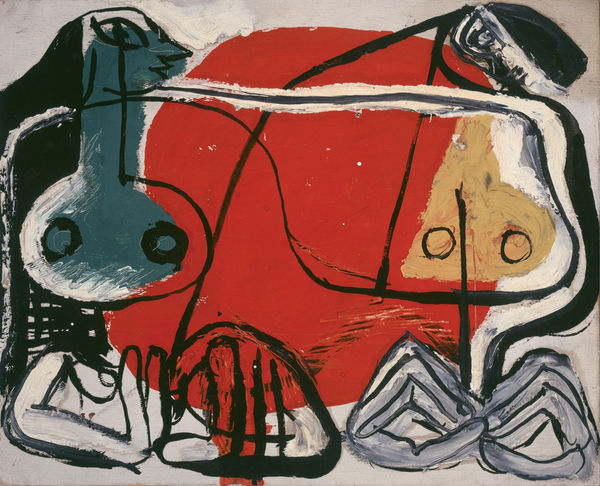
LE CORBUSIER French/Swiss, 1887-1965

"Space and light and order. Those are the things you need as much as bread or a place to sleep."
Le Corbusier (1887–1965) is regarded as one of the defining figures of modernism and as one of the most influential architects, artists, and theorists of the twentieth century. From the 1920s onwards, he developed a visionary creative language that united architecture, painting, drawing, sculpture, and design. His work is distinguished by a sustained exploration of proportion, space, and light, establishing new standards for modern architecture and artistic thought. In addition to his architectural practice, Le Corbusier's oeuvre encompasses paintings, drawings, prints, sculptures, tapestries, and furniture designs. His visual works combine constructive clarity with organic forms, reflecting his enduring interest in the relationship between art, architecture, and human scale. Works by Le Corbusier are held in major international museum and private collections, including the Museum of Modern Art (MoMA), New York, the Centre Pompidou, Paris, Tate, London, and the Vitra Design Museum, Weil am Rhein. Through his work, Le Corbusier made a decisive contribution to the development of modern architecture and the interdisciplinary understanding of art in the twentieth century.
-
 LE CORBUSIERDeux autres dames grecques, 1959Oil on wood22 x 27 cm
8 5/8 x 10 5/8 in -
LE CORBUSIERFemme et mains, 1962Oil on paper35 x 28,5 cm
13 3/4 x 11 in -
LE CORBUSIERNature morte, 1962Grattage on black grounded white glossy paper35 x 50.2 cm
13 3/4 x 19 3/4 in